
AI Won’t Save You from Drowning in Work, but These 3 Concepts Will
In a workforce increasingly dependent on AI, productivity is not improving. The real solution is mastering these frameworks.
I can’t open any social media application without an ad for a new AI tool promising to 5x your productivity and solve all your problems. Young professionals trying to get ahead are bombarded with these pitches. Need better scheduling? There’s an AI tool for that. Need to take better notes? AI has you covered. Struggling to balance project deadlines? AI, baby.
Yes, artificial intelligence is here to stay, for better (we hope) or worse, and those quick to adopt are promised an edge over their peers. But these tools are still just that—tools. They solve problems at a surface level, and no amount of intelligence will replace talent and intuition. Sure, AI can help schedule your day, but what are you doing in those working blocks? AI can break down project deadlines, but how are you solving the individual components?
The truth is, AI is only as powerful as the person using it. These tools are not mythical artifacts that imbue you with knowledge. They are better processors that help you work faster, but they do not do the work for you. So now that I have gotten my cynicism out of the way, what will help you avoid drowning in work?
What Did We Do Before AI?
From 2015 to 2021, I worked at a SaaS startup—a tiny, bootstrapped fintech firm. When I say bootstrapped, I mean each person wore five hats, and there was always a fire to put out. I was the only dedicated finance person for most of my tenure. If it involved dollars and cents, it was under my purview—accounts receivable, accounts payable, financial close, revenue, sales ops, reporting, audits, and more.
Execution at speed and operational clarity were necessary for survival. When you have five fires daily, you put them out fast or risk setting the whole company ablaze. You must understand priorities daily, communicate effectively, and stay agile as circumstances change. It takes time and commitment to master these principles through practice and repetition.
At the time, I did not have a name for my strategies—I was figuring it out. But looking back, I realized I was reinventing the wheel. Here are the three concepts that helped me survive and thrive in that environment.
The Eisenhower Matrix: Prioritization for Maximum Impact
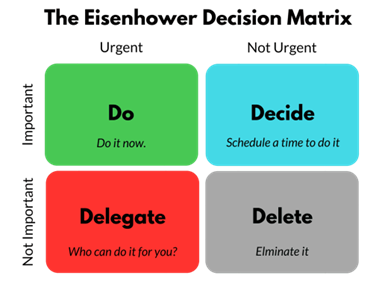
This well-known concept was developed by Dwight D. Eisenhower, the 34th President of the United States, to prioritize tasks and manage time. He used the matrix during World War II to plan the D-Day invasion of Normandy and later referenced it in a 1954 speech, stating, “I have two kinds of problems, the urgent and the important. The urgent are not important, and the important are never urgent.” And it’s literally that simple. Ask yourself these four questions when a request comes across your inbox, Slack, or Teams.
· "Must I do this right now?" (Urgent & Important)
"Can I schedule this proactively?" (Important, Not Urgent)
"Can someone else handle this?" (Urgent, Not Important)
"Can I remove this completely?" (Not Urgent, Not Important)
What actions do you take? Let’s say a coworker emails you, “Hey, I need this report. Can you help?”
Now, you also have to couple this with proactive communication. That means clearly stating your approach, timelines, and ownership when responding to requests.
What does this look like in action? Let’s say a coworker emails you, “Hey, I need this report. Can you help?”
Do: If urgent and important, proactively respond, “I’ll handle this now and let you know when it's done.”
Decide: If it’s important but not urgent, set clear expectations, “I’ll have this ready by Thursday—will update you as soon as it’s complete.”
Delegate: If urgent but better handled elsewhere, communicate clearly, “I'm looping in [name] who handles this; they'll follow up with you shortly.”
Delete: If the task is obsolete or assigned elsewhere, proactively clarify, “This report has been deleted or is now managed by [name]; please reach out to them directly.”
What if You Can't Delegate?
Well, I have a replacement, Defer. Batch low-level tasks during low-energy periods so they don’t interrupt deep work. Decide is hyper-focused time - no distractions, no multitasking, just full concentration on one important task. Defer is for low-effort tasks like scheduling meetings, following up on deliverables, or handling routine admin work. These don’t require deep focus, so instead of letting them break up your day, you batch them into a designated time when your energy is lower, keeping high-impact work uninterrupted.
Decide - Plan proactively for focused time.
Defer - Batch during low-energy periods.

With this version, Decide moves under Urgent but Not Important, emphasizing the need to schedule tasks proactively before they become urgent. Defer becomes Important but Not Urgent, ensuring low-energy tasks are grouped efficiently. This keeps your workflow structured, prioritizes deep work, and prevents unnecessary disruptions.
Occam’s Razor: The Power of Simplicity
A lot of work is navigating BS. Excuse the sailor talk, but it’s the truth. In my previous post, I spoke about paper pushers and the façade of appearing busy. The unintended consequence of paper pushing is the goal or mission gets lost in a fog of obfuscation (Bullshit), or so many subtasks and peripheral goals get added that the whole thing topples over. This is called Christmas tree legislation in Congress, where a bill meant to address one issue gets overloaded with unrelated amendments and riders. Instead of solving the original problem, it becomes a vehicle for political bargaining, weighed down by additions until it collapses under complexity.
This is where Occam’s Razor comes in. It is the idea that the simplest solution is usually the best one. When applied to decision-making, it means cutting through unnecessary complexity and focusing on what matters. When you remove the excessive, you get to the real problem and solve it faster. Applying this means cutting through the noise, shutting down pointless additions, and keeping the focus on what moves the needle. It is the difference between a clean, functional day and one that gets so bloated with “nice-to-haves” that it ends up doing nothing well.
In action, Occam’s Razor looks like this:
What are you trying to solve?
What is the simplest way to solve it?
Does this deliverable get the best result?
Let’s use it in an example.
A sales manager asks you, “Can you put together a full report on last quarter’s sales, including detailed breakdowns by region, product category, and individual sales reps? Also, add some projections for the next two quarters and any trends you think are relevant.”
Applying Occam’s Razor to Stay Agile and Avoid Unnecessary Work:
What are you actually trying to solve?
→ Instead of assuming, you clarify the real need (in a friendly way, of course):
"Happy to help. Just so I target this right, what’s the main question you’re looking to answer? Do you need a quick snapshot or something more detailed?"What is the simplest way to solve it?
→ If they need trends or key numbers, you suggest a lighter, more efficient approach:
"I can send a one-page summary with key figures and trends instead of a full breakdown. Would that work for you?"Does this deliverable get the best result?
→ You make sure you’re providing value without unnecessary bloat:
"Here’s a concise summary of sales trends and projections. Let me know if you need anything deeper."
Why This Works:
Instead of overcommitting, you clarify the ask, offer a streamlined solution, and keep your workload focused. This keeps you working lean and agile while delivering exactly what’s needed. Coupling this with the Eisenhower matrix, you now efficiently planned your workload for the day.
The RACI Matrix: Alignment Without Friction
So, you have mastered the first two items. You are planning your time effectively, keeping your work streamlined, and delivering simple, high-impact solutions. But despite this, you are still getting pulled in different directions—stuck in meetings that don’t need you, weighed down by decisions outside your scope, or constantly asked to “help out” on things that aren’t your responsibility.
Enter RACI.
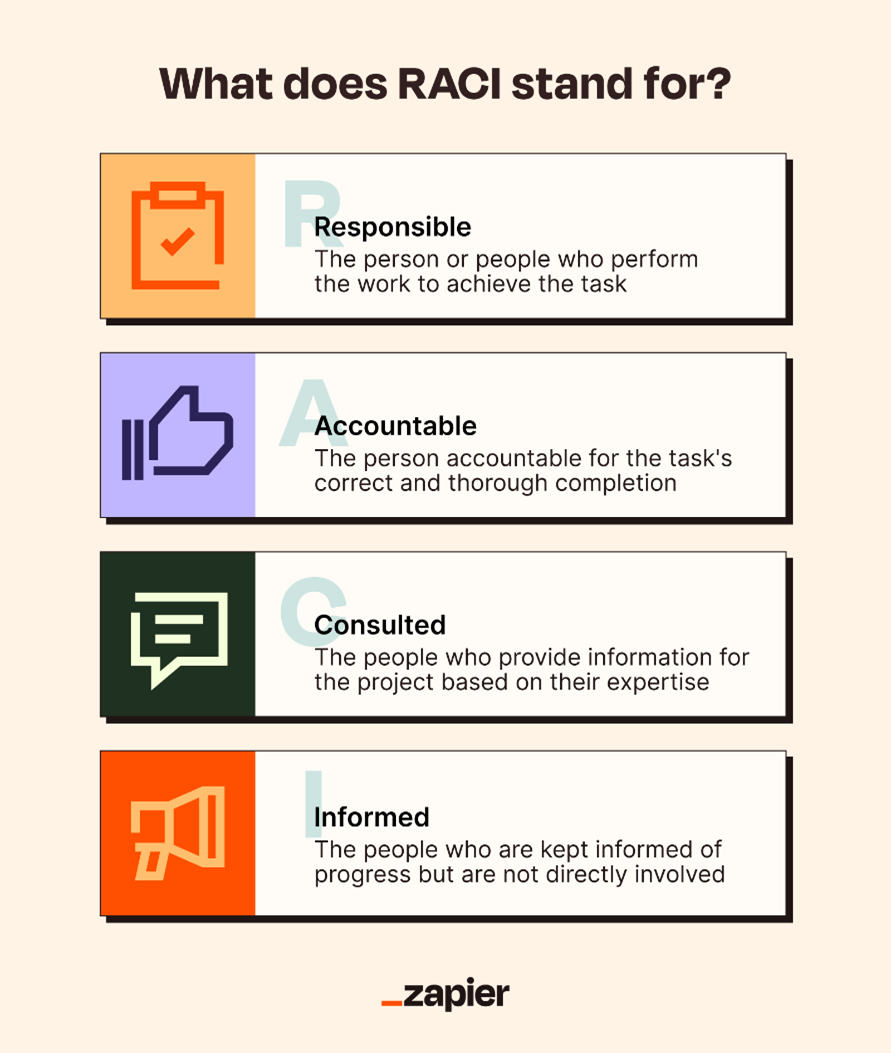
RACI is a framework that clarifies who is responsible for what, ensuring everyone knows their role in a project or task. It prevents unnecessary involvement, reduces friction, and keeps you focused on the work that matters. Instead of constantly firefighting or picking up tasks that should be owned by someone else, you can stay in your lane and work smarter.
Breaking It Down: What is RACI?
RACI stands for:
Responsible – The person or people doing the work to complete the task.
Accountable – The owner of the task who ensures it gets done.
Consulted – People who provide input but don’t own execution.
Informed – Those who need updates but don’t contribute directly.
Applying RACI prevents confusion about who should be involved and when. You are not sitting in meetings because someone “thought you might need to be there.” You are not picking up tasks that were never yours to begin with. Instead, you align your work with the right responsibilities—and push back on anything that does not fit your role.
How This Keeps You Focused
When a new request comes in, instead of automatically saying yes, ask:
Am I responsible for executing this, or should I just be consulted?
Is this my accountability, or should I stay informed?
If this isn’t my responsibility, who owns it?
By filtering work through RACI, you cut out distractions, protect your time, and work without unnecessary friction.

Let’s revisit the example we used for Occam’s Razor. You are a BizOps manager, and the request for a full sales report has now been turned into a dashboard built for leadership. To keep this from spiraling, you apply the RACI matrix. Biz Ops is responsible for execution and accountable for delivering the final dashboard. Sales own making sure it happens. The CFO and Accounting are consulted or kept in the loop where needed. Accounting gathers the data with Biz Ops, ensuring it gets done. Once the dashboard is live, Biz Ops runs training, Sales ensures it gets adopted, and the CFO and Accounting stay informed. This keeps the project focused, avoids unnecessary work, and delivers exactly what leadership needs: nothing more.
The real hack comes when you master these frameworks and then prompt your AI tool of choice to execute them for you.
Sustainable Execution Without Burnout
AI can optimize, but it will not replace structured decision-making. Tools do not think for you; they process faster. Without a clear system, AI will only speed up the mess, not clean it up. You can automate scheduling, generate reports, and analyze data instantly, but none of that matters if you are still stuck doing work that should have been cut, handed off, or deprioritized. AI does not fix broken workflows—it just moves inefficiency along faster.
The Eisenhower Matrix, Occam’s Razor, and RACI are not abstract theories; they are how you stop spinning your wheels. They let you cut through the noise, make decisions faster, and focus on what matters. When used consistently, they help you get more done without working yourself into the ground. The goal is not to be busy; it is to be effective.
Start applying these today. The next time a request hits your inbox, run it through the matrix, strip out anything unnecessary, and ensure the right person owns it. If it is your responsibility, figure out the simplest way to get it done. If it is not, send it where it belongs. Execution is not about doing more; it is about doing what needs to be done. The real hack comes when you master these frameworks and then prompt your AI tool of choice to execute them for you. AI is just a tool—it is only as powerful as the person using it.